Monday, January 23, 2012

Greetings From the Yaeda Valley!

A group of students photograph the sun setting over the Yaeda Valley. Photo Credit:  Steven Pope

A group of Wildlife students observe the African Spoonbill from a distance. Photo credit: Stephen Pope

A young Hadza hunter examines the Kirk’s dikdik that he caught during the morning hunt. Photo credit: Kimberly Blasnik

Mel Cleary laughs as she struggles to set her arrow during target practice. Photo credit: Aileen Hearn

Three Hadza use smoke to draw bees out of the hive in order to retrieve honey. Photo credit: Kimberly Blasnik


We’ve made the trip from the chilly Nou Forest to the sweltering Yaeda Valley. It was a full day of truck travel, but driving in Tanzania is never boring. We stopped at a wetland along the way to see some Great Crested Grebes, a bird rarely found in Tanzania. Once in the valley we were fortunate to spend time with the Hadza, a tribe of hunter-gatherers. Early one morning we ventured out with the Hadza hunters and returned successful with a Kirk’s dikdik and klipspringer. Upon returning from an exciting morning of hunting, a small group of wildlife students headed to a seasonal wetland for an afternoon of birding while the rest of the group hiked to a cave containing ancient rock art from an unknown tribe. That evening the Hadza prepared klipspringer kabobs with a side of Kirk’s dikdik stew, it was delicious! After our exotic dinner, the Hadza treated us to a night of traditional song and dance around the campfire. The following day, ten brave students made the 24km trek to meet the rest of the group at our second campsite in the Yaeda Valley. The Hadza then shared with us the art of hand-crafted arrows or “mishale” after which we had target practice. Our best archers were Erin Cordiner, Carly Burrus, Stephen Pope, and Matt Fischel. We were instructed to use “power” when drawing the bow and the Hadza were thoroughly entertained when Stephen Pope, in his concentration, cracked the bow in two. On our final day in the valley we joined the Hadza women in their village to dig tubers or “mizizi”, a potato-like root. We also had the opportunity to sample raw honey from a hive in a nearby Acacia tree. Our time with the Hadza has been unforgettable. We have been inspired by the pride they take in their work and the fun they having doing it!

Sunday, January 22, 2012

Mambo!

The group poses in traditional Tanzanian attire with the Hadza atop sacred rocks overlooking the Yaeda Valley. Photo credit: Jon Cox

Sunday, January 15, 2012

Adventures in the Nou!

Photo credit Nick Sheehan. Some of the students celebrating their arrival at the Nou Waterfall after the long hike.

Photo credit Jen Lo Dico. Local Iraqw children surround photography student Amelia Wang in awe as she shows them pictures of the soccer game.

Photo credit Amelia Wang. Karoli’s mother shares her wisdom by advising the students to respect their elders.

This image was captured by the wildlife group’s infrared hidden camera around camp depicting a timber poacher, that was used to help capture the thief the next day.

Photo credit Jen Lo Dico. Karoli approaches his mother’s traditional Iraqw home in the village.


We woke up to a cold, windy morning. The calls of the Schalow’s Turaco filled the air as we stumbled from our tents, nestled in the mossy trees of the Nou Forest. Venturing out before dawn, students photographed the mesmerizing sunrise with Jon. After breakfast, we left for a guided hike around the Nou Forest finding traces of leopards, hyenas, and elephants.
Returning to camp we had a relaxing afternoon filled with Swahili lessons and yoga. While on the way to capture the sunset, students saw blue monkeys and ran into local Iraqw children tending their cattle. United by soccer, a game broke out despite the language barrier. Laughter was heard on both teams and only finished when the children had to return to their cattle. After dinner, we huddled around the campfire gazing at millions of stars and were even lucky enough to see some shoot across the sky.
The next day, after breakfast, Karoli, an Iraqw forest ranger, welcomed us into his farmland home and taught us about the Iraqw’s traditional way of life and the importance of agriculture. With the help of Maggie, our Swahili instructor, we were able to sing the Tanzanian National Anthem with Karoli’s son, friends and neighbors.
The wildlife group set up infrared cameras every day to attempt to capture images of wildlife activity.  Some of the pictures that came back included two porcupines and a poacher holding a suni, a small forest antelope. The most exciting image they captured was a timber poacher, which is a serious offense in Tanzania. Karoli is going to use the image to bring the poacher to justice and use him as an example for future thieves.
The last full day in the Nou Forest was spent hiking the challenging, muddy, six-mile hike to the Nou waterfall. Despite the cold, the students eagerly jumped in and stood beneath the roaring water.
Once returning to camp, we were able to add words to our growing Swahili vocabulary and had a viewing of the photography group’s, “Why I came to Tanzania” video projects. The wildlife group continues to work on their daily surveys and have added the Silvery-cheeked Hornbill, Montane Nightjar, and Olive-flanked Robin-chat to their checklists, among others. Today we arrived at the Yaeda Valley and met the Hadza, a hunter-gatherer tribe.  Check back to learn about our new friends!

Friday, January 13, 2012

Habari Asubuhi!


The sunrise view from our campsite in the Nou Forest.
 
Film by Holly Pierson


Check back soon to hear about the rest of our adventure in the Nou!

Thursday, January 12, 2012

Habara za mchana! Good Afternoon!

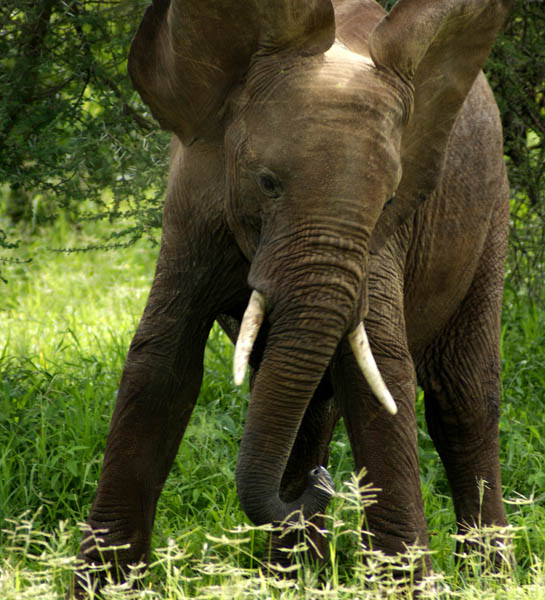
We woke up today not knowing what was in store for us. Hiking up to the peak of Oldonyo Sambu was treacherous yet invigorating. With Maasai warriors as our guides we conquered our fears and successfully reached the summit where we were immersed in panoramic views of the lush Maasai Steppe. The next day we packed up camp, loaded the trucks, and made our way to Tarangire National Park. A rainy day brought vehicles stuck in the mud, but on the bright side we saw hundreds of African Elephants. Together we pushed through and arrived at Tarangire Lodge. After sleeping on the ground for the past week, we were more than delighted to be welcomed with beds and warm showers. The following morning we awoke for an early game drive. A first for everyone, including Jon and Jake, we witnessed an elephant carcass covered by scavenging Hooded Vultures, African White Backed Vultures, and Marabou Storks. A relaxing afternoon by the poolside provided a perfect view of the abundant wildlife in the savanna below. During our late afternoon drive we encountered a lone musting bull elephant and while observing him from our truck, he became agitated and started to aggressively approach. As everyone froze we were overwhelmed by a primitive connection to the environment and realized that we were experiencing nature. As the elephant gave its final warning, our guide Daudi said, “It’s okay boy,” and he backed down. It was then time to depart from the Tarangire Lodge and set out for the Nou Highland Forest. With our accent to higher elevation we traveled through villages and witnessed a transition from grasslands to forest. Who knows what the Nou Highlands will have in store for us as we embark on yet another adventure.


An elephant puts on a display as our truck drives passed in Tarangire National Park.  
Photo by: Carly Burrus
 

Among the crowd of vultures and storks, one individual spreads its wings as a display of dominance. As the vultures pick meat from the carcass the Marabou Storks patiently wait for scraps.
 Photo by: Carly Burrus
 
Two Maasai warriors rest on the top of Oldonyo Sambu overlooking their land, the Maasai Steppe.  
Photo by: Morgan Fiore

During our travel on the Maasai Steppe, the sky opened up and painted sunlight across the horizon highlighting Oldonyo Sambu, which we climbed the next day. 
Photo by: Holly Pierson 

Our safari truck driver Habibu spotted this little Flap Necked Chameleon on the side of the road. Maggie and Jon jumped out and we all observed it change colors. 
Photo by: Holly Pierson

Saturday, January 7, 2012

JAMBO!

Photo by Chris Stejskal.  Social interaction between two giraffes at Arusha National Park


Photo by Alyssa Wlosinski. A rare sighting of a Beesley’s Lark scouting the Engikaret Lark Plains


Photo Mel Cleary. Elizabeth, one of the Olitisi children waiting for her turn to get off the bus to see the view in Arusha National Park


Photo by Mel Cleary. Stephen Pope searching for wildlife in Arusha National Park with Elizabeth, one of the Olitisi orphaned children


Despite the jet lag we all woke up excited to begin our first day in Tanzania. After breakfast, the photography students spent the day with a group of orphans making bracelets and wire sculptures; their talent blew us away. We also visited Shanga, a remarkable facility where people with disabilities blow glass out of recycled beer and wine bottles to earn a living. Part of their profits from the beads and other products go to an organization, which benefits disabled children. Aileen Hearn was lucky enough to blow glass herself. The wildlife group went to the Engikaret Lark Plains in hopes of seeing the endangered Beesley’s Lark, the most rare bird in Tanzania. These birds are being protected through the practice of community-based conservation, which is funded by visitors like us. We were lucky to see six of these birds, in addition to over 100 other bird species by travelling in open trucks and exploring the landscape by foot.  The diversity of species was humbling.  The next day, we went to Arusha National Park with twelve of the orphans saw zebras, giraffes, buffalo, and olive baboons, two of which were white (which is awesome)! We left Arusha the following day with our cameras and binoculars ready for an eight hour safari (Swahili for journey) to the Maasai Steppe. In the final hour we drove through a torrential downpour until we reached our destination where we were greeted by the warm, welcoming faces of our Maasai hosts. Check back for more adventures to come!


Wednesday, January 4, 2012

We Made It!

Jambo from Tanzania! We all made it here safely (including our luggage) and we are enjoying ourselves already!  Here's a watercolor of camp painted by Katie Yost! Stay tuned for our next post with more images to come!